Why Polish Offices Reject UK "Certified" Translations — and What a Sworn Translation Is
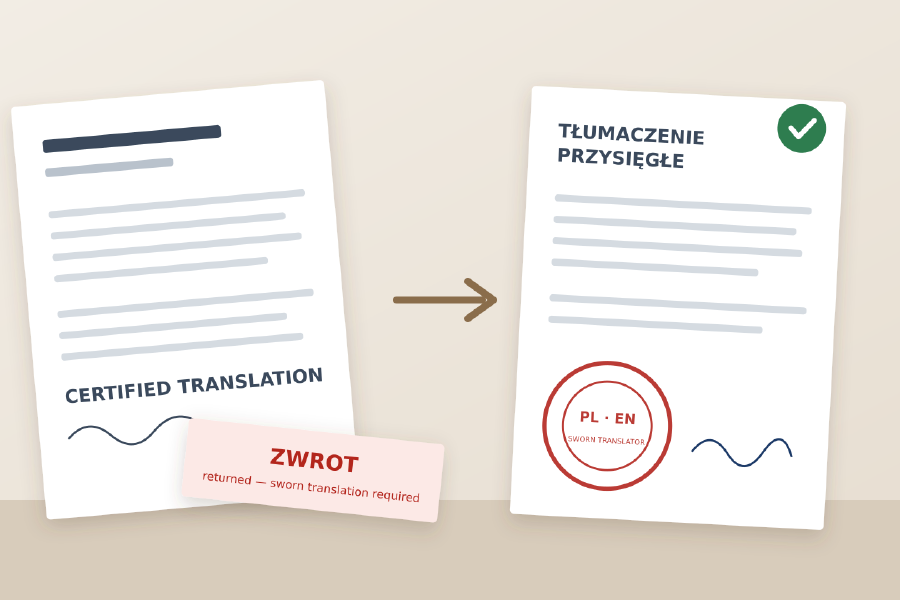
If a UK document is going to a Polish office, a UK “certified” translation is usually not enough. Polish law asks for a sworn translation, made by a translator authorised under Polish (or EU/EEA) rules.
It is a scenario I see every month. A client registers their child’s UK birth in Poland, or a solicitor sends divorce papers to a Polish court. They pay for a certified translation from a reputable UK agency. Weeks later the papers come back from the Urząd Stanu Cywilnego (registry office) with a note: please provide a sworn translation.
The UK translation was not bad. It was simply the wrong kind of document for a Polish authority.
Why Polish offices say no
Polish law decides who may translate a foreign document for an authority, and a UK certified translator is not on that list.
For civil-status matters, Article 31 of the Polish Civil Status Records Act (Prawo o aktach stanu cywilnego) says a foreign-language document must come with an official Polish translation made by one of three people (full text):
- A sworn translator entered on the list kept by the Polish Minister of Justice.
- A sworn translator authorised to make such translations in an EU or EEA member state.
- A Polish consul.
The UK has no sworn-translator system. Since Brexit it is also outside the EU and EEA, so the second route is closed too.
The Consular Section of the Polish Embassy in London states this plainly. Its translator list warns that certified or diplomaed translators working in the UK are, as a rule, not recognised as sworn translators (Embassy list). It adds that the Polish office may return the document or ask for a sworn translation, which delays the case.
In short: “certified” in the UK is a promise of quality from a translator or agency. “Sworn” in Poland is a legal status granted by the state.
What a sworn translation is
A sworn translation (tłumaczenie przysięgłe) is a translation made and certified by a tłumacz przysięgły: a translator appointed by the Polish Minister of Justice.
The profession is governed by the Act of 25 November 2004 on the profession of sworn translator. To be appointed, a translator must pass a state exam in translating both into and out of Polish, take an oath, and be entered on the Ministry’s public list. Each sworn translator has a personal entry number, such as TP/67/14.
On paper, a sworn translation has features a Polish clerk will look for:
- The translator’s official seal, showing their name, the language and their list number.
- A certification clause confirming the translation agrees with the document it was made from.
- A note on the source: whether the translator worked from the original, a certified copy or a scan.
- A description of non-text elements, such as stamps, signatures and handwritten notes on the original.
- A register number, because every sworn translation is logged in the translator’s official register.
That is why a sworn translation is accepted as a public document in Poland. The translator, not an agency, takes legal responsibility for it.
When you are likely to need one
Most UK documents heading to a Polish authority need a sworn translation into Polish. The most common cases I handle:
- Registering a UK birth, marriage or death in Poland (transkrypcja) at a Urząd Stanu Cywilnego or through a Polish consulate.
- Applying for a Polish passport or PESEL number for a child born in the UK.
- Court proceedings in Poland: divorce, child arrangements, inheritance and debt claims.
- Notarial matters: powers of attorney, property sales and probate documents.
- Company documents for a Polish branch, tender or business partner: certificates of incorporation, accounts, contracts.
- Education and work: UK degrees, transcripts and DBS certificates for Polish employers or universities.
The same rule applies in reverse for many UK cases. Polish documents for UK courts and solicitors are often best translated by a sworn translator, because the translation carries a clear chain of responsibility.
Requirements can vary between offices and change over time. If in doubt, ask the receiving office what it will accept before you order.
How to get it right first time
- Check the translator’s status. Ask for their sworn-translator number and look them up on the Polish Ministry of Justice list, or on the Polish Embassy’s list of translators in the UK.
- Say where the translation is going. “For the registry office in Kraków” tells the translator exactly what form and wording the office expects.
- Send clear, complete copies. Include both sides of each page, every stamp and every annex.
- Allow for the post. A paper sworn translation carries an original seal and signature, so it travels by post rather than email.
Need a sworn Polish–English translation?
I am Ewa Hayward, a sworn Polish–English translator appointed by the Polish Ministry of Justice and a full member of the Chartered Institute of Linguists (MCIL). I am listed by the Consular Section of the Polish Embassy in London, and I work at legal aid rates.
Ordering is simple:
- Email a scan or photo of your document to [email protected], use the form at ewa-hayward.co.uk, or post the original within the UK.
- Get a free quote.
- Receive your sworn translation on paper by post, usually within 3–5 days.
Solicitors and businesses with regular Polish work are welcome to get in touch about ongoing arrangements.